
Installeer de app
Hoe de app installeren op iOS
Volg de onderstaande video samen om te zien hoe u onze site kunt installeren als een web-app op uw startscherm.
Notitie: Deze functie is mogelijk niet beschikbaar in sommige browsers.

Je gebruikt een verouderde webbrowser. Het kan mogelijk deze of andere websites niet correct weergeven.
Het is raadzaam om je webbrowser te upgraden of een alternatieve webbrowser te gebruiken.
Het is raadzaam om je webbrowser te upgraden of een alternatieve webbrowser te gebruiken.
James Webb Telescope (JWTS)
- Topic starter inVorm
- Startdatum
- Recente activiteit Recente activiteit:
- Reacties 108
- Weergaven 16.844
- Volgers 12

- Lid sinds
- 5 apr 2005
- Berichten
- 13.530
- Waardering
- 11.758
- Lengte
- 1m71
- Massa
- 86kg
- Vetpercentage
- 10%
This image from the NASA/ESA/CSA James Webb Space Telescope depicts IC 1623, an entwined pair of interacting galaxies which lies around 270 million light-years from Earth in the constellation Cetus. The two galaxies in IC 1623 are plunging headlong into one another in a process known as a galaxy merger. Their collision has ignited a frenzied spate of star formation known as a starburst, creating new stars at a rate more than twenty times that of the Milky Way galaxy.
- Lid sinds
- 5 apr 2005
- Berichten
- 13.530
- Waardering
- 11.758
- Lengte
- 1m71
- Massa
- 86kg
- Vetpercentage
- 10%

- Lid sinds
- 25 sep 2007
- Berichten
- 10.770
- Waardering
- 1.528
- Lengte
- 1m86
- Massa
- 96kg
- Vetpercentage
- 15%

- Lid sinds
- 3 okt 2008
- Berichten
- 35.644
- Waardering
- 35.310
- Lengte
- 1m85
- Massa
- 108kg
- Vetpercentage
- 10%
Hoe zouden de leden van de CU of de SGP dit noemen? De hand van god?

- Lid sinds
- 5 apr 2005
- Berichten
- 13.530
- Waardering
- 11.758
- Lengte
- 1m71
- Massa
- 86kg
- Vetpercentage
- 10%
- Lid sinds
- 5 apr 2005
- Berichten
- 13.530
- Waardering
- 11.758
- Lengte
- 1m71
- Massa
- 86kg
- Vetpercentage
- 10%
Nog niet.Is de dumbell-nebula al vastgelegd met james webb? ( ja die bestaat echt)

- Lid sinds
- 8 mrt 2007
- Berichten
- 8.688
- Waardering
- 1.269
- Lengte
- 1m96
- Massa
- 118kg
- Lid sinds
- 5 apr 2005
- Berichten
- 13.530
- Waardering
- 11.758
- Lengte
- 1m71
- Massa
- 86kg
- Vetpercentage
- 10%
Titan is the only moon in the solar system with a dense atmosphere, and it is also the only planetary body other than Earth that currently has rivers, lakes, and seas. Unlike Earth, however, the liquid on Titan’s surface is composed of hydrocarbons including methane and ethane, not water. Its atmosphere is filled with thick haze that obscures visible light reflecting off the surface.


- Lid sinds
- 5 apr 2005
- Berichten
- 13.530
- Waardering
- 11.758
- Lengte
- 1m71
- Massa
- 86kg
- Vetpercentage
- 10%
Some of the first data from NASA’s James Webb Space Telescope has shown there were at least two, and possibly three, more unseen stars that crafted the oblong, curvy shapes of the Southern Ring Nebula. Plus, for the first time, by pairing Webb’s infrared images with existing data from ESA’s (European Space Agency’s) Gaia observatory, researchers were able to precisely pinpoint the mass of the central star before it created the nebula. A team of almost 70 researchers led by Orsola De Marco of Macquarie University in Sydney, Australia, analyzed Webb’s 10 highly detailed exposures of this dying star to produce these results.
Their calculations show the central star was nearly three times the mass of the Sun before it ejected its layers of gas and dust. After those ejections, it now measures about 60 percent of the mass of the Sun. Knowing the initial mass is a critical piece of evidence that helped the team reconstruct the scene and project how the shapes in this nebula may have been created.

Their calculations show the central star was nearly three times the mass of the Sun before it ejected its layers of gas and dust. After those ejections, it now measures about 60 percent of the mass of the Sun. Knowing the initial mass is a critical piece of evidence that helped the team reconstruct the scene and project how the shapes in this nebula may have been created.
- Lid sinds
- 5 apr 2005
- Berichten
- 13.530
- Waardering
- 11.758
- Lengte
- 1m71
- Massa
- 86kg
- Vetpercentage
- 10%
- Lid sinds
- 5 apr 2005
- Berichten
- 13.530
- Waardering
- 11.758
- Lengte
- 1m71
- Massa
- 86kg
- Vetpercentage
- 10%
A new analysis of distant galaxies imaged by NASA’s James Webb Space Telescope shows that they are extremely young and share some remarkable similarities to “green peas,” a rare class of small galaxies in our cosmic backyard.
“With detailed chemical fingerprints of these early galaxies, we see that they include what might be the most primitive galaxy identified so far. At the same time, we can connect these galaxies from the dawn of the universe to similar ones nearby, which we can study in much greater detail,” said James Rhoads, an astrophysicist at NASA’s Goddard Space Flight Center in Greenbelt, Maryland, who presented the findings at the 241st meeting of the American Astronomical Society in Seattle.

“With detailed chemical fingerprints of these early galaxies, we see that they include what might be the most primitive galaxy identified so far. At the same time, we can connect these galaxies from the dawn of the universe to similar ones nearby, which we can study in much greater detail,” said James Rhoads, an astrophysicist at NASA’s Goddard Space Flight Center in Greenbelt, Maryland, who presented the findings at the 241st meeting of the American Astronomical Society in Seattle.
- Lid sinds
- 5 apr 2005
- Berichten
- 13.530
- Waardering
- 11.758
- Lengte
- 1m71
- Massa
- 86kg
- Vetpercentage
- 10%
The largest and brightest region of star formation in the Local Group of galaxies, including the Milky Way, is called 30 Doradus (or, informally, the Tarantula Nebula). Located in the Large Magellanic Cloud, a small neighbor galaxy to the Milky Way, 30 Doradus has long been studied by astronomers who want to better understand how stars like the Sun are born and evolve.


NGC 346, one of the most dynamic star-forming regions in nearby galaxies, is full of mystery. Now, it is less mysterious with new findings from NASA’s James Webb Space Telescope.

NASA’s James Webb Space Telescope has imaged the inner workings of a dusty disk surrounding a nearby red dwarf star. These observations represent the first time the previously known disk has been imaged at these infrared wavelengths of light. They also provide clues to the composition of the disk.

NASA’s Webb Confirms Its First Exoplanet
Researchers confirmed an exoplanet, a planet that orbits another star, using NASA’s James Webb Space Telescope for the first time. Formally classified as LHS 475 b, the planet is almost exactly the same size as our own, clocking in at 99% of Earth’s diameter. The research team is led by Kevin Stevenson and Jacob Lustig-Yaeger, both of the Johns Hopkins University Applied Physics Laboratory in Laurel, Maryland.
NGC 346, one of the most dynamic star-forming regions in nearby galaxies, is full of mystery. Now, it is less mysterious with new findings from NASA’s James Webb Space Telescope.
NASA’s James Webb Space Telescope has imaged the inner workings of a dusty disk surrounding a nearby red dwarf star. These observations represent the first time the previously known disk has been imaged at these infrared wavelengths of light. They also provide clues to the composition of the disk.
- Lid sinds
- 5 apr 2005
- Berichten
- 13.530
- Waardering
- 11.758
- Lengte
- 1m71
- Massa
- 86kg
- Vetpercentage
- 10%

If you want to build a habitable planet, ices are a vital ingredient because they are the main source of several key elements — namely carbon, hydrogen, oxygen, nitrogen, and sulfur (referred to here as CHONS). These elements are important ingredients in both planetary atmospheres and molecules like sugars, alcohols, and simple amino acids.
- Lid sinds
- 5 apr 2005
- Berichten
- 13.530
- Waardering
- 11.758
- Lengte
- 1m71
- Massa
- 86kg
- Vetpercentage
- 10%
An international team of astronomers using NASA’s James Webb Space Telescope has obtained an in-depth inventory of the deepest, coldest ices measured to date in a molecular cloud. In addition to simple ices like water, the team was able to identify frozen forms of a wide range of molecules, from carbonyl sulfide, ammonia, and methane, to the simplest complex organic molecule, methanol. This is the most comprehensive census to date of the icy ingredients available to make future generations of stars and planets, before they are heated during the formation of young stars.

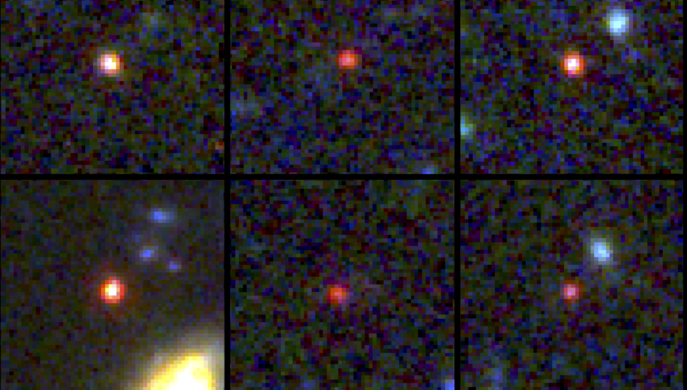
James Webb Telescope spots galaxies from the dawn of time that are so massive they 'shouldn't exist'
The James Webb Space Telescope spotted six gigantic galaxies, each roughly the size of our own Milky Way, that formed at a bafflingly fast pace — taking shape just 500 million years after the Big Bang.
 www.livescience.com
Soortgelijke topics
- Reacties
- 2
- Weergaven
- 211


- Reacties
- 12
- Weergaven
- 326


- Reacties
- 5
- Weergaven
- 472
