Je vorige reactie was alsvolgt.

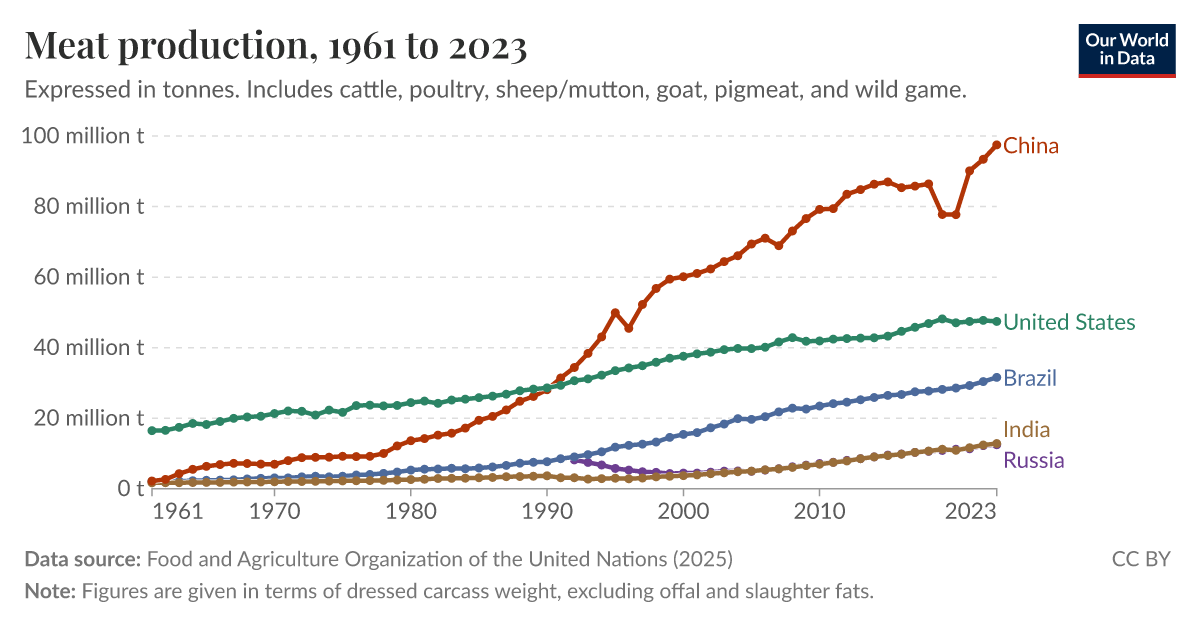
Klopt, de ruimte is op dit moment niet op, we kunnen voldoen aan de huidige vleesvraag en zouden we die betere verdelen(dikkerds eten minder, dunne meer), dan kunnen we nog meer voldoen in de vraag. Daarom hoeven we dus NU niet minder vlees te eten. Of we dat over 40 jaar moeten weten we niet.
Omdat je zo geïnteresseerd bent in het milieu:
Maar lees het vooral weer niet en maak er je eigen ding van waar je omheen kan lullen.
Zoals ik hiervoor al zei kunnen we dit alleen op aannames doen en laat juist net dit artikel daarmee vol staan en de auteurs geven dit ook toe. Dingen die we niet kunnen voorspellen zijn de bevolkingsgroei (maar we proberen het wel), culturele verschillen die komen of gaan, technologische vooruitgang (hele belangrijke, benoemen zij zelf ook), oorlogen en andere (grote) factoren die van invloed kunnen zijn op een een voorspelling 40 jaar in de tijd. Ze proberen het met de huidige informatie zo goed mogelijk te analyseren en gokken, maar of dit gaat uitkomen is nog maar zeer de vraag. Zie hieronder voor de quotes. Zo dat heb ik weer mooi verdraaid hé?
Here we show that between
2010 and 2050, as a result of expected changes in population and income levels, the environmental effects of the food
system could increase by 50–90% in the absence of technological changes and dedicated mitigation measures, reaching
levels that are beyond the planetary boundaries that define a safe operating space for humanity. We analyse several
options for reducing the environmental effects of the food system, including dietary changes towards healthier, more
plant-based diets, improvements in technologies and management, and reductions in food loss and waste. We find that
no single measure is enough to keep these effects within all planetary boundaries simultaneously, and that a synergistic
combination of measures will be needed to sufficiently mitigate the projected increase in environmental pressures.
Uncertainties
Our estimates are subject to several uncertainties. Some of the planetary-
boundary values have a large uncertainty range, which reflects the
difficulties of scaling up local environmental pressures to global levels
12,20
in particular regarding bluewater use and nitrogen and phosphorus
application (seeMethods). The planetary-boundary framework can
therefore provide only a very broad measure of the sustainability of
the food system. Our analysis indicates that using the upper bound
of the planetary-boundary range increases the option space (Fig.3)
and, for example, does not require reductions in food loss and waste
or a more optimistic socioeconomic development pathway; however,
meeting the lower bound of the planetary-boundary range would
sequestration, while reducing GHG emissions, could put additional
pressures on croplands or pastures, with implications for land-use
and biodiversity targets. Other areas for further research include the
quantification of co-benefits of food-system change, for example, on
health
15,49
, biodiversity
50
, and the economy
47
, as well as context-specific
metrics of sustainability and a greater focus on livelihood, for example
in terms of food security
51
Our analysis suggests that the environmental impacts of the food
system could increase markedly owing to expected changes in food
consumption and production, and, in the absence of targeted measures,
would exceed planetary boundaries to the extent that key ecosystem
processes could become at risk of being destabilized. Synergistically
combining improvements in technologies and management, reduc-
tions in food loss and waste, and dietary changes towards healthier,
more plant-based diets, with particular attention to local contexts and
environmental pressures, will be a key challenge in defining region-
specific pathways for the sustainable development of food systems
within the planetary option space. We hope that the country-specific
data and suite of scenarios produced for this study (see Methods, ‘Data
availability’) can provide a good starting point for this endeavour.